
The Journey from Traditional Networking to Cloud Networking (Azure)

I’ve spent a lot of years doing “traditional” networking. ASIC-based switches, hand-built BGP adjacencies, both sides of every connection configured and verified before I’d trust it. So when I recently went deep into deploying Cisco FTDv firewalls as Network Virtual Appliances (NVAs) into an Azure Virtual WAN vHub, I expected the usual: configure my side, configure Azure’s side, watch the neighbour come up.

That’s not what happened. And that gap between what I expected and what actually happens is, I think, the single most important thing to explain to any network person making this jump. So that’s where I’m going to start.

Azure Doesn’t Want You to Touch It, and That Feels Like a Trust Issue

Here’s the thing that will throw you off if you’ve done “real” networking for a while: in Azure Virtual WAN, you don’t configure the other side of the BGP relationship.

Enable Routing Intent on the Azure Portal, and Azure will start BGP peering with your NVA. You will never see a BGP neighbour listed in the portal for it. Not because something’s broken — because Azure never asked you to configure one. The Azure vHub router’s ASN isn’t something you set either; it’s Azure system-assigned the moment the hub gets created. Make sure you’re aware of these Azure ASN reservations so you don’t accidently use them (internet search “azure reserved asn numbers”).

With Routing Intent, there are no Azure route tables to babysit either. Routing Intent is a one and done affair.

If you’re coming from traditional networking, this is going to feel like a trust issue. You’re used to being able to see both sides of an adjacency. In Azure, half of it is invisible to you by design. My advice: don’t fight it. Follow the vendor’s Azure-specific onboarding document (in my case, Cisco’s FTDv guide) to the letter, and stay away from general Azure BGP documentation while you’re doing it. The general docs describe a different mental model and will just confuse you mid-deployment.

The IP Address That Isn’t “For Example”

Buried in the Cisco documentation is a line that says “For example: 168.63.129.16.” I want to flag this specifically because I think it’s a trap.

168.63.129.16 is not an example. Type that exact address. It’s Azure’s “magic” virtual IP — a fixed address, consistent in every single Azure region, that serves as the dedicated endpoint for DNS, DHCP, and health probes. If you read past that line assuming it’s a placeholder like most documentation examples are, your health probe will never work, and neither will your BGP pairing, because Azure won’t consider your NVA operational until that probe succeeds.

A few more things in this same neighbourhood that got flagged as “explain this clearly or someone will burn a day on it”:

  • The internal load balancer’s health probe needs a static route configured on the NVA side, and the FTDv’s HTTP server needs to be enabled with an ACL letting that probe through on the internal interface.
  • Your static routes to the Azure vHub gateway need to stay at metric 1. The NVA isn’t directly connected to the vHub router, so it has to reach it via static route — and if that route’s metric is higher than BGP’s default of 20, you’ll get route flapping.
  • Under BGP advanced settings, check the box for “Disable Connection Verification.” Azure needs it checked.
  • You do not need a user-defined route (a UDR, in Azure-speak) on the vHub side. If you’re hunting for where to add one, stop — there isn’t one. Again, Azure Routing Intent is one-and-done, there is nothing to do on the Azure side of things. Likely the issue is on the NVA side so go back to the vendor NVA documentation and triple check everything.

Sizing Your Hub: The Decision You Don’t Get a Second Chance At

This next part isn’t a “gotcha,” it’s just math that’s easy to skip past during initial design and painful to discover later. Making this error means standing up a new Data Centre or having multiple Data Centres. The networking world is working on 10-20 year cycles, not the faster server world cycles of 5-10 years. We want to make design decisions that last.

Every Azure Virtual WAN hub reserves a fixed pool of IP addresses for NVA subnets, and that pool size is locked in by the hub’s address space when it’s created. It doesn’t matter whether you’re using the capacity or not — it’s static, and changing it later means rebuilding.

Here’s how the address space choice plays out:

vWAN Hub Address Space (for NVA vNet allocation)IPs per NVA subnetMax Scale units per NVA as dictated by Vendor (example Cisco with Cisco’s max throughput figures)Max vHub theoretical limit with all 16 NVAs deployed
/23 or smaller1140288 Gbps
/222780480 Gbps
/215980480 Gbps
/20 or larger12380480 Gbps

Pick a /23, and you’re capped at 288 Gbps hub-wide and 40 scale units per NVA. Go to /22 or bigger and both numbers jump — 480 Gbps and 80 scale units. My recommendation is at least a /22. Honestly, since most organizations aren’t using this private address space for anything else, I’d go as far as suggesting a /20 just to future-proof against whatever Azure changes down the road. It costs you nothing today. The maximum number of NVAs per hub is always 16, regardless of size — so this decision is really about how big each of those 16 can eventually get (Azure scaling with additional VMs), not how many you can deploy.

Flow Limits: The Outage Nobody Notices Coming

If you only budget for bandwidth, you’re going to get burned by this one.

Every VM, and therefore every NVA, has a maximum bidirectional flow limit — and for an NVA it is half of what the underlying VM’s rated connection capacity is — and this is a hard spike ceiling, not a long-term average. Blow past it, and connections get dropped. Not politely refused. Just dropped. The client machine keeps retrying a TCP handshake that will never finish, and to the end user, it looks like the app is frozen or spinning forever, with zero indication of why.

This always matters but it matters more if your NVA is doing double duty. An NVA handling both north/south and east/west traffic — which is a pretty normal pattern for an Azure landing zone — is eating into its flow budget from two directions at once, and needs to be sized accordingly from day one, not after the help desk tickets start rolling in. Be mindful of where the backups are going, that’s going to be the big flow generator if it goes via the firewall.

Should You Cluster the FTDvs? My Answer: Probably Not

Azure High Availability is not supported with clustering. That one line should stop you before you get excited about clustering as the “enterprise” answer. In Azure, the only reason to cluster is to auto scale and that introduces complexity most enterprise organizations don’t need.

Without clustering, Azure’s built-in internal load balancer already does most of what you’d want:

  • Traffic is already load balanced to all the VM FTDv instances in the NVA by default.
  • Want to pull a VM FTDv in the NVA out of service? Remove its health probe static route. Done — traffic stops immediately.
  • Scale up and add a new VM FTDv instance? It comes up without an active health probe route, so it stays silent until you deliberately turn it on.

That’s a manual process, sure. But it’s predictable and low-drama, and it doesn’t drag in the cost and operational overhead of a full autoscaling pipeline — which for FTDv means standing up Azure Function Apps and Logic Apps and a whole different deployment process. For a shop that isn’t building toward serious autoscaling, that complexity isn’t buying you much.

Clustering on in Azure with Cisco FTDv also comes with a list of unsupported features so always be careful to read the caveats before implementing . What might not be supported? This is the list for Cisco: remote access VPN (SSL VPN and IPsec VPN, site-to-site VPN, Virtual Tunnel Interfaces (VTIs), High Availability, Integrated Routing and Bridging, to name a few — plus real operational care and feeding: disabling health checks around any topology change, never pulling more than one node out of a scale set at a time, disabling clustering on a node before removing it. None of that is a dealbreaker if you need clustering. It’s just a cost you should go in knowing about.

My take: clustering earns its complexity when you’re actually building toward autoscaling. If you’re not there yet, the built-in load balancer and manual scaling gets you the same outcome with a lot less to manage.

Where This Leaves You

If there’s one idea I want a traditional networking person to walk away with, it’s this: Azure Virtual WAN isn’t hiding half the configuration from you out of carelessness. It already did that half of the work before you logged in. The ASN you never set, the BGP neighbour you’ll never see in the portal, the route table you configure once and never touch again — none of it is missing. It’s just handled.

The engineers who get comfortable with this fastest are the ones who stop hunting for the configuration step that isn’t there, and start trusting the health probes and Routing Intent to do the job that “both sides configured” used to do by hand.

About the Author

Trevor Textor specializes in solving problems that have organizations stuck. That means he does pretty broad things from A-Z and somewhere in there yes, he helps out with networking. Sharing what he learns the hard way is a hallmark of Trevor’s work. Ask Trevor if he can help: anyskill.ca/afc-capability-matrix.


The Barriers to Better Internet – Comment and Share!

Where is this tower?
Who owns it?

We all want more Internet in more places. Most folks assume that the stage is set to make this happen. Unfortunately, no it is not. As an Internet builder myself, I can say that, yes, funding is an issue but it’s not the first hurdle. The initial barriers to better Internet involve data. That is, there is no infrastructure map or market to help build the Internet. These are things we need before we can even look at the issue of funding. Let’s explore what I mean.

Explaining the Barriers to Better Internet

I’ll use an analogy because it simplifies things and takes the industry specific terminology off the table. We want to build a house. We have nails but where do we find the wood? There is no equivalent of a home hardware store to go to. Instead what we have are wood piles placed all over the country sitting unused. How do we find the wood piles? Who owns them? What kind of lumber is it specifically? (2×4? 2×6? Length? etc.)

Most first world governments do supply funding but it is typically for building more of these hidden wood piles.

What exactly are these “wood piles”? They are “passive infrastructure” needed to build the Internet. Things like towers, conduits and cables (like fiber). And this infrastructure is shareable; meaning they are more like a 40-story office tower than a single-family home. The nails are active infrastructure like radio and cable transceivers which are readily available. But where do you install these things if you don’t have any passive infrastructure to install them on? How do you create a budget that is reasonable? (That is, not build absolutely everything from scratch; which is how we do it today.) This is the challenge of Internet builders and it affects urban and rural but rural to a much greater extent.

Rural Problem? Urban Problem? First World Problem?

Here in Canada, there is tons of empty passive infrastructure across the nation but it is hard to find, figure out who owns it and then to strike a deal in which to share it.

But based on what I’ve seen, this problem certainly exists in both the USA and Canada and it is highly likely most other jurisdictions around the globe. It is just the degree of the problem that will vary.

Canada has a partial database of passive infrastructure for towers called “Spectrum Direct” but adding information about the towers is an afterthought. That is, its intended use is to track wireless (spectrum) licenses and only collects data on where the radio is as meta data about the license (an afterthought). This doesn’t track any unlicensed wireless or “free” wireless. On a tight budget, which would you expect to be used? This means it doesn’t have data on towers for 10s of thousands of towers. Further, the database doesn’t validate the passive infrastructure information and does not indicate ownership of the passive infrastructure. 

On other geospatial databases, nothing seems to be public and whatever there is a patch-work across provinces. I’ve checked with IHS, Esri and even Bell / Telus. In fact, Telecom companies often don’t even know what they own. In one story, a peer of mine reported a fiber pedestal that Bell owned to Bell. Bell didn’t know about it. It turned out they had acquired a company that owned the fiber and had not incorporated the information into their main geospatial database. This is if they even have a main database? It could be spread across multiple databases. A 2013 article by Esri located here explains how Bell better used GIS. This article does not inspire confidence that telecom companies have excellent geospatial databases.

USA has a bit better database, the FCC’s Antenna Structure Registration (ASR) database, but it only tracks towers above 100’. Nothing about smaller infrastructure that is equally as useful to wireless and will be even more so with 5G. There is nothing about private infrastructure or accessing cable.

In urban locations, my own community specifically, Enmax has been laying empty conduit in alleyways. Telus has been “planning” to lay fiber for at least 7 years, probably more. I know rural communities that have fiber to the premises faster. Are Enmax and Telus communicating about what assets are in the ground? Hopefully? Probably not. So urban situations, a little bit better, but clearly not a lot better.

Ground Truthing is not the Answer

Sure, we could drive around urban and rural Canada “ground truthing” to figure out what is there every single time we want to build more Internet. But not all infrastructure is located along roads. And even if you do find something, often times the infrastructure is physically unmarked with ownership information. I have unmarked boxes in my community in Calgary, in rural areas the problem is infinitely worse.

But should we have to drive around mapping everything every time we have a project to build better Internet? This is a mapping process that takes between 1 to 18 months for every single Internet building project being undertaken in every single jurisdiction, every country, etc. This mapping process has to be completed before applying for funding (including government funding!). It introduces considerable delay and expense.

We’re in the year 2020. Why is this data problem not being addressed? I would hope that it’s crystal clear that this data problem is central to resolving the barriers to better Internet. In my experience though, most people do not know about this. And they are further shocked to hear that the Internet is mostly a low profit margin business.

The Internet is mostly a low Profit Margin Business

I hear you: “Wait? What?”. The money in the Internet is in high density/volume (e.g. smartphones). Every other Internet related business has lower margins. The lower the density, the lower the margin. So cabling households with fiber in urban communities is something Telecom companies only do organically over time unless subsidized. This is why Google Fiber has been so slow to expand and hasn’t built anything for the past four years. It takes a lot of creativity to make the funding work.

The fact is, consumers and businesses do not want to spend a lot of money on Internet. It’s a utility now. The cheaper it is, the better for the economy. So, for rural areas, their exceptionally low density makes the situation incredibly dire. Rural profit margins are usually negative. This is the reason why rural areas are a low priority for Telecom companies. Even with government subsidies to help bring the profit margin above zero, rural projects are still lower priority due to lower profit overall and poor prospects for growth.

Taking Down the Barriers to Better Internet

We need two things:

  1. A government policy requiring all Telecommunication assets to be registered to a no-fee publicly accessible geospatial database. Oil & Gas is already required to do this. They have to register every pipeline, every compressor, every plant, etc. to a no-fee publicly accessible geospatial database. Why shouldn’t Telecommunications similarly have to register?
  2. A marketplace for passive infrastructure; a “rentfaster” site for building the Internet. Need to make an offer someone can’t refuse? This shouldn’t take years. It should take less than an hour. And renting passive infrastructure is already proven to work. That’s why ~70% of the world’s towers are already shared, just not here in Canada; read more about that here.

These items would create a marketplace that would drive Internet growth. It would create a vibrant market that could start solving the problem on its own with less and less government funding and intervention and in less time. Based on all this, where are our respective governments with respect to providing funding and direction to this problem? Canadian government: Zilch. US government: Nothing that I know of.

Next Steps?

Overall, I’m looking for like minded individuals willing to volunteer some time. Possibly next step would be to start a petition but I’d like to discuss and develop this idea. If you can’t do much, please share this message and help me reach out to more like-minded folks. There is no requirement to have technical knowledge in this area and many times cross discipline knowledge is critical.

While We Wait for the Barriers to Better Internet to Fall

I’ve written an article that explains some things households, and sometimes businesses, can do to help improve their Internet service without waiting for the larger forces of the Internet to make things happen. Click here for my article “Forget a bandwidth upgrade! Try these 4 things to make the home internet experience better”.

About the Author

An avid writer, Trevor Textor has been quoted by Reader’s Digest, NBC News, Reviews.com and MarketWatch.com among others. Over the course of 20 years Trevor has designed and built many small rural Internet builds across the globe. “It’s slower than dial-up” is something he knows personally (move mouse, wait 10 seconds, screen re-draw, try again) and has since used his passion to look for ways to help build better Internet. How Trevor pays his bills is as a freelancer providing a “swiss army skillset” and a proven ability to successfully assist many small, medium and large businesses in most areas of their business. Please consider clicking here to ask Trevor and his partner if they can help via their freelancing corporation “Textor Corp.”.

The Gender Pay Gap Explained

Education and Experience explained only 8% of the gender pay gap according to the “Progress on the Gender Pay Gap 2019” study. Occupational differences, e.g. the career that was chosen, explains 56%. Not “who you know” or specifically targeting women. “I think what’s important to recognize there is that women and men don’t randomly sort into occupations, partly because of influences early on: what kind of jobs get taught to people as being a male job or a female job. And some jobs, frankly, just aren’t friendly to family lifestyles.”

The kind of jobs with a large part-time pay gap are generally in areas where it’s harder to divide up hours and be flexible. Any job where relationships need to be maintained with clients are especially bad; e.g. careers in sales, lawyer, banker, etc. There are jobs that pay a part-time premium and these tend to be jobs where it’s easy for people to swap shifts or work as a team. E.g. Nursing, waiters/waitresses

“When an occupation pays less money per hour to its part-time workers than to its full-time ones, it’s known as the part-time penalty. That penalty tends to be higher when occupations have less flexible hours. Here’s the catch: the jobs that tend to be more flexible — and ones that many women and mothers gravitate towards — pay less.”

So how can the gap be reduced? “…[E]ither men would also have to increasingly choose those flexible occupations or the rigid, inflexible occupations would have to become less rigid and inflexible so that women and mothers could join them, perhaps by, you know, embracing more of a team approach at work.”

Sources:

“Where The Gender Pay Gap Is Widest”

https://www.npr.org/sections/money/2019/04/29/718389455/where-the-gender-pay-gap-is-widest

“Progress On The Gender Pay Gap 2019” study

https://www.glassdoor.com/research/studies/gender-pay-gap-2019/

Source: “Jobs Friday: The Part-Time Penalty”

https://www.npr.org/2019/05/03/720122267/jobs-friday-the-part-time-penalty

Planet Money Talks Trade Wars And The Batman Problem

Instead of a trade-war which impacts the global economy and hurts everybody, why not just use anti-currency manipulation to address the trade deficit? As explained by Planet Money’s “indicator” podcast it’s practically free. What it doesn’t do is buy politicians votes… The world economy just might be suffering in order for a politician to get re-elected…

https://www.npr.org/sections/money/2018/07/18/630265851/trade-wars-and-the-batman-problem

Published in Reader’s Digest “11 Hidden Reasons Your Internet Is So Slow”

Yes, the Reader’s Digest. Access their article here:

11 Hidden Reasons Your Internet Is So Slow (Oct 1, 2018)

They quoted a popular post I wrote in 2015:

Forget a bandwidth upgrade! Try these 4 things to make the home internet experience better

Note: Reader’s Digest is owned by “Trusted Media Brands, Inc.” and the article may also be displayed on other sister sites such as Family Handyman: https://www.familyhandyman.com/smart-homeowner/diy-home-improvement/hidden-reasons-your-internet-is-so-slow/

Regulatory Capture is to Blame – Reducing RC starts with Education

What’s to blame for slower growth and rising inequality? Regulatory capture. And who practices Regulatory Capture? EVERYONE “Regulatory capture is a form of government failure which occurs when a regulatory agency, created to act in the public interest, instead advances the commercial or political concerns of special interest groups that dominate the industry or sector it is charged with regulating. When regulatory capture occurs, the interests of firms or political groups are prioritized over the interests of the public, leading to a net loss for society. Government agencies suffering regulatory capture are called “captured agencies””. This is an issue that is a “bipartisan blind spot” and affects politicians from any political view.

“…[I]t’s ultimately the duty of the governors to make sure that the rules are in the public interest, rather than in the narrow interests of the various clamoring claimants who come before them.” The first step to eliminating regulatory capture is to recognize that it happens.

One of the reasons the public tolerates regulatory capture is that special interest groups use a positive policy image which creates a natural blind spot in the public’s eyes. An example used by Planet Money is teeth whitening and North Carolina’s Dental Board. The public feels that dentists help people so when the NC Dental Board lobbied to get a regulation to stop non-dentists from offering simple tooth whitening services the dentists initially won. Teeth whitening is more like a pedicure for your teeth rather than a dental procedure and anyone can do one. In fact, these days, people can buy teeth whitening kits at the grocery store. It had to go to the supreme court for the regulation to be removed. While waiting for all the legal trials to settle the issue stifled competition (natural market forces): teeth whitening service costs were artificially inflated (bad for consumers) and non-dentists were put out of business. Planet Money explains a few more examples and including one where homeowners practice regulatory capture.


Sources:

Planet Money’s story called “Rigging The Economy” https://www.npr.org/templates/transcript/transcript.php?storyId=592376568

https://en.wikipedia.org/wiki/Regulatory_capture

https://www.washingtonpost.com/outlook/whats-to-blame-for-slower-growth-and-rising-inequality/2017/11/22/97bb9e6c-b805-11e7-a908-a3470754bbb9_story.html?noredirect=on&utm_term=.dddf9ae2c60b

https://marketbusinessnews.com/financial-glossary/regulatory-capture-definition-meaning/

The Value of Second Opinions

Just 12% of diagnosis by Doctor is correct. See Mayo study for more details on the study – click here.

Don’t forget doctors are just one expert on your team. Value 2nd, 3rd and fourth opinions and hopefully those include other disciplines. General practitioners favor dispensing drugs, surgeons favor surgery, etc…. there are alternative therapies that don’t include drugs (and side effects).

More on my posts about doctor / patient relationships here.

Planet Money Talks About Organ Donations And How To Increase Them

Empathy is not an effective way to encourage people to be on an organ registry. But simply asking them when they are not thinking about it (via DMV registry) is extremely effective. It works because we are annoyed and distracted and not thinking about death. Interestingly, Alberta recently made this change, to ask the question at the registry, just this year.

http://www.npr.org/blogs/money/2014/02/19/279664019/episode-518-how-to-bore-someone-into-donating-an-organ

How North American Energy Can Compete – Enablement of a Digital Oilfield with a “Connected Field”

Did you know that accountants were hesitant to adopt spreadsheet programs like excel? Or that it took us decades to fully adopt trains, automobiles and computers? Do you think these things changed our lives? Of course! How could we conceive where we are today without them? But it took a while for them to gain “steam” (pun intended).

The situation with the Digital Oilfield in North America follows these familiar lines. It is a transformation that I cannot adequately explain since I only know how to build the enabling technology. How it’s going to be used is up to each person acting individually and resulting in a collective connected effect. Sure, I can give some examples or find people who have done this or that. But that’s the tip of the iceberg. The “killer example” is going to be different for every team in an energy company.

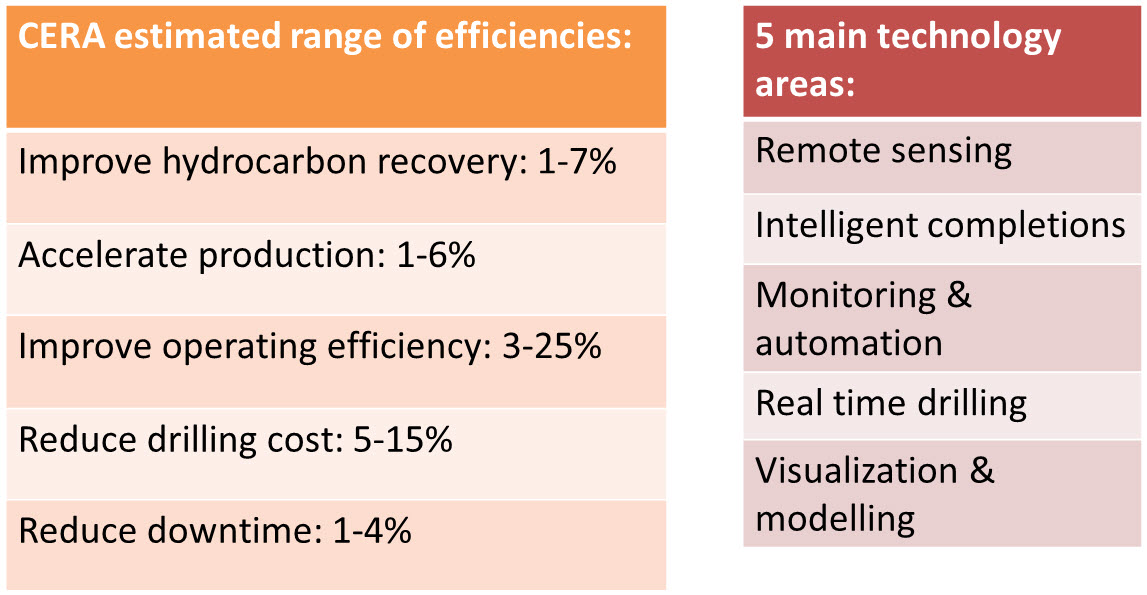
The enabling technology for the Digital Oilfield is called a “Connected Field”. It takes the Oilfield improvement areas listed below and binds them together. It’s the enablement of seamless intercommunication and coordination that truly leverages a Digital Oilfield. Without it, it’s an Oilfield that uses new Oilfield technology – not the exciting “Digital Oilfield” that truly propels the energy business to the next level.

There are so many ways to get a Connected Field wrong for a Digital Oilfield. Even with the right telecom vendors, it’s so easy to say “we don’t need QoS (Quality of Service)” – simply because the decision maker doesn’t know what it is. The fallacy is that there is a belief we already have a Digital Oilfield. There are already real world examples of a true Digital Oilfield using a Connected Field. And they are all in the Middle East; lowering their costs and increasing their supply. I cover a real world example later, so it will be easy to see the difference.

But let’s go back to the beginning. What is a “Digital Oilfield”?  The concept was first presented in the seminal study: “The Digital Oilfield of the Future: Enabling Next Generation Reservoir Performance”, IHS Cambridge Energy Research Associates, Inc., 2003.

A Digital Oilfield makes the following improvements to the Oil & Gas business – and a Connected Field enables most of them; that is, you need a connected field to truly leverage the benefit to the full extent.

So what is a “connected field”? It is a data communications system that has these characteristics:

  • Completely and seamlessly covers the area of interest (like cellular data might cover all of the downtown of a city). This allows users to just turn on a device (sensor, video, etc.) reducing or eliminating the need to involve IT to justify a business case to obtain capital to expand the network. It just works. Technicians are not required to tune antennas at the user level. A rig can just move itself and still have full connectivity to all its services while it is moving and when it reaches its destination.
  • It is a committed That is, it is not a “best effort” network, shared with other companies and people in the area (like cellular data).
  • It allows full control – that is, it has quality of service (QoS) capabilities to prioritize business critical applications or applications requiring better service to function correctly (voice, video).

Let’s examine what is not a connected field:

  • Cellular data from any major telco. The reason why it is not is that it has no QoS and is best effort (no committed bandwidth) and may not cover the entire field without boosters (which are technically illegal according to the Telecommunications Act).
  • MPLS networks – in themselves, they would help if the purchaser buys QoS. If the cost of buying the right networks with QoS was used to price the rent option, it is likely that the system could be built from scratch less expensively. That is, a Digital Oilfield should consider the “rent vs buy” options like any procurement decision.
  • Satellite – the price per Mbps with QoS and dedicated bandwidth is horrendously expensive. Unless the company (including all teams and phases that work in the area) only expects to operate in the area for 6 months or less, it’s frequently the case that it is cheaper to build.
  • SCADA (legacy 450 & 900Mhz) – really this is only for “tin can on a string” SCADA data – that is monitoring / telemetry. There are now new SCADA radios that can supply QoS and bandwidth rates at 18Mbps or above but most Oil & Gas companies, especially in North America are not using them. Most of the SCADA radios in use today use technology that was developed during World War II and they have not been updated. We’re talking punch card era technology.

And of course, I hear all the skeptics. So what does a Digital Oilfield do  in practice? Here’s an example:

Petroleum Development Oman (PDO)

  • Connected field coverage: 45,000 sq. km (17,000 sq. miles)
  • Increased a mature (brownfield) oilfield’s production by 100K barrels/day. At $90/barrel this is $3.2 Billion/year in additional revenue within one year. (Ok, yes, price of oil… but this was done in 2012 – even at $30 that’s $1 Billion)
  • Reduced drilling & completion days to online from 39 days to 14 days ($1M per drill saved). Including completions, saved $5M per well.
  • 10 month payback.

What does the Connected Field network look like for PDO?

As of the end of 2013, Petroleum Development Oman field has:

  • 6600 broadband connection points
  • 52 base stations
  • 13 Gbps total capacity, the equivalent of 500 connected homes or the bandwidth provided to a 4000 person office building
  • 130,000 end devices

Compare this to a field of that size in North America; there are maybe 10 cellular base stations covering the entire thing. Everything overloaded to the point that it does not work that well (e.g. “worse than dialup” is what I frequently hear).

Together the Connected Field collects 36 times more data enabling more accurate and improved decisions. It delivers 4 Mbps anywhere within the field of coverage (compared to less than 300kbps in some fields available today). You can drive around in a truck all day long and everything just works.

No messing with devices, changing networks, etc. Need to talk to the engineer in head office and start a video chat about a valve to show him/her the valve? Done! No problems. Want to implement an intelligent video system to monitor the flare stack, look for pipeline leaks, identify personnel not wearing PPE, etc.? Want a “mobile worker”? (Please do not confuse it with a “mobile OS” which is simply an operating system built to enable mobile workers that have a network.) With a Connected Field, you just do it! No need to price in a brand new network to enable the business case.

The cost of all this? Less than 1% of the total injected capital into a greenfield area. And if a true connected field is implemented that is multi-use and multi-team capable, the expenditure is less than what they spend today.

Despite the impressive track record how many Digital Oilfields are there in North America? None. Some are close with partial implementations but it’s localised and not well championed at the executive and board levels. How many in the Middle East? Quite a few. Middle East operations have the direct support of the board of directors/families and executives. Would this situation have any bearing on the current supply / demand and geopolitical climate? Hmm….